Neighbours sharing food, childcare and arguments
The region should remember ordinary closeness as strongly as loss: borrowed pots, favours, gossip and disagreements.
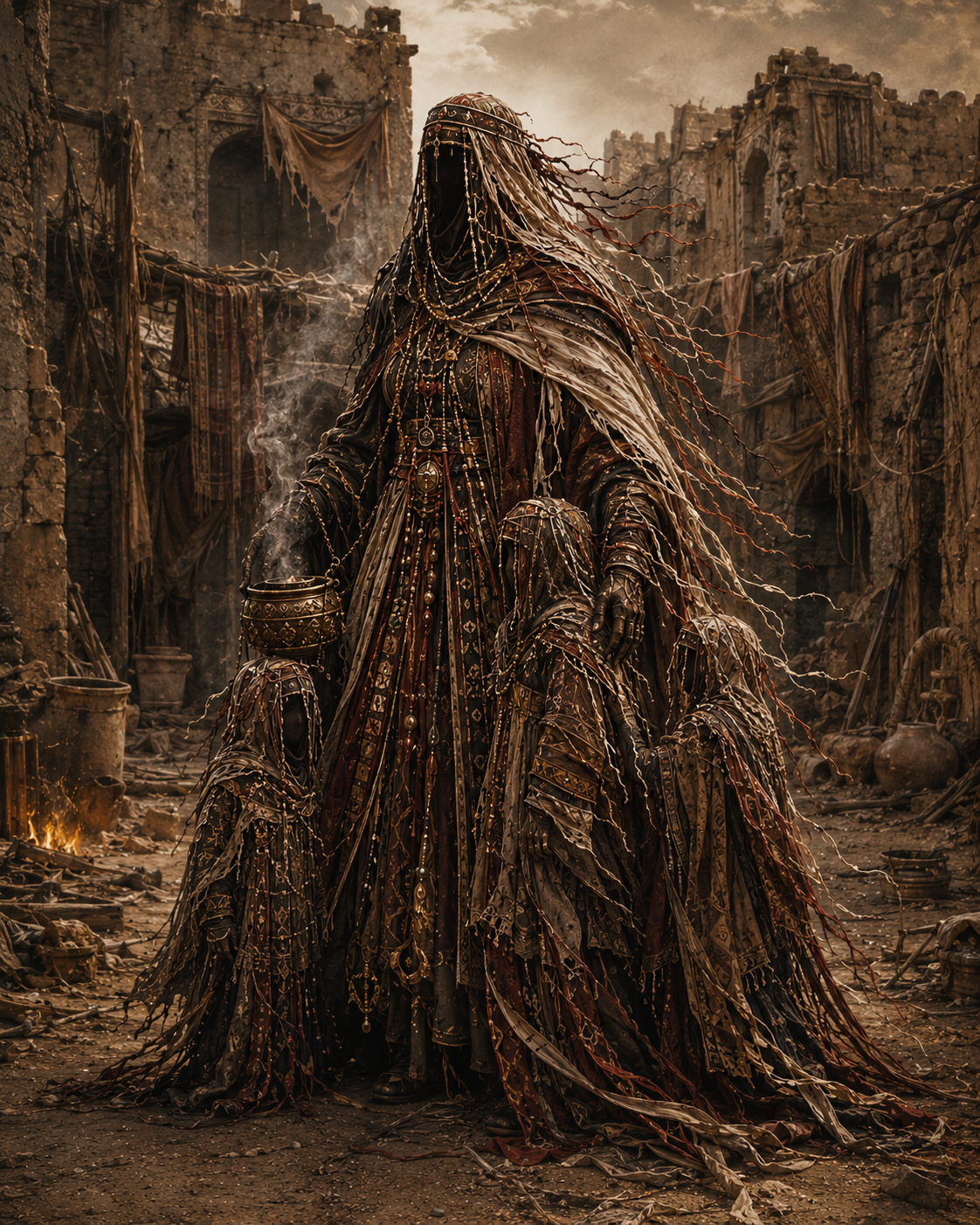
Hosh al-Dar preserves the ordinary warmth of home: cooking fires, children, neighbours and protective routines held in ash and memory.
THE FIGURE AT THE HEART OF THIS REGION
The Hearth
Qamaris was not built only by kings, soldiers, scholars and judges. It was built in its courtyards. Hosh al-Dar was a place of crowded homes, shaded passages, merchants calling across narrow streets, children running between neighbours, food shared across doorways and families whose lives overlapped until an entire district seemed to breathe as one household.
Among them lived Maryam. She was remembered not for office or rank, but because people came to her when something had gone wrong: a hungry child, a grieving family, a quarrel between neighbours, someone with nowhere else to sleep. Maryam believed a kingdom survived because ordinary people chose to care for one another.
When Qamaris began to collapse, she refused to abandon those entrusted to her. She gathered them close. She closed the doors. And when the fires came, Maryam remained inside with them.
In Rufat, they remember her by another name: Mother of Cinders.
This is foundational story context for contributors. The deeper cause of what happened to Qamaris is intentionally left unexplained here.
THE PEOPLE OF THIS PLACE
Start with a person, routine or relationship. Each angle below points toward a different kind of story.
The region should remember ordinary closeness as strongly as loss: borrowed pots, favours, gossip and disagreements.
Play can leave marks behind — chalk, stones, songs, rules and tiny rivalries that survive in memory.
A habit like checking a blanket, cooling food or calling someone inside can become quietly devastating after the ruin.
VISUAL LANGUAGE
Domestic courtyards, cooking spaces, family objects, communal gathering places, ash and woven materials. The ruin should preserve evidence that ordinary warmth once filled this place.
EXAMPLE CONTRIBUTIONS
These are non-canon examples. Use them to understand the scale and tone, then take your idea somewhere different.
A host Echo sets out four cups for guests but only three are ever used. A chipped cup found elsewhere can connect to the missing place without explaining everything.
Children's marks survive across a courtyard floor. Echoes keep arguing about whose turn it was, giving the region a memory of play rather than only grief.
An Echo keeps asking for a cooking pot back from the house next door. The joke gradually reveals how closely families shared tools, food and daily life.
QUESTIONS TO CARRY WITH YOU
You do not need to answer every question. One strong answer is enough to begin a contribution.
What game might children have played here?
What object could remind someone of home?
What family routine might an Echo repeat?
IF SOMETHING SPARKED
A memory, character, sketch, room, object or unfinished thought is enough. The Workshop can help shape it to fit Rufat.