Guards waiting for relief that never comes
Duty can survive its purpose. A tiny shift routine may say more about the gate than another battle story.
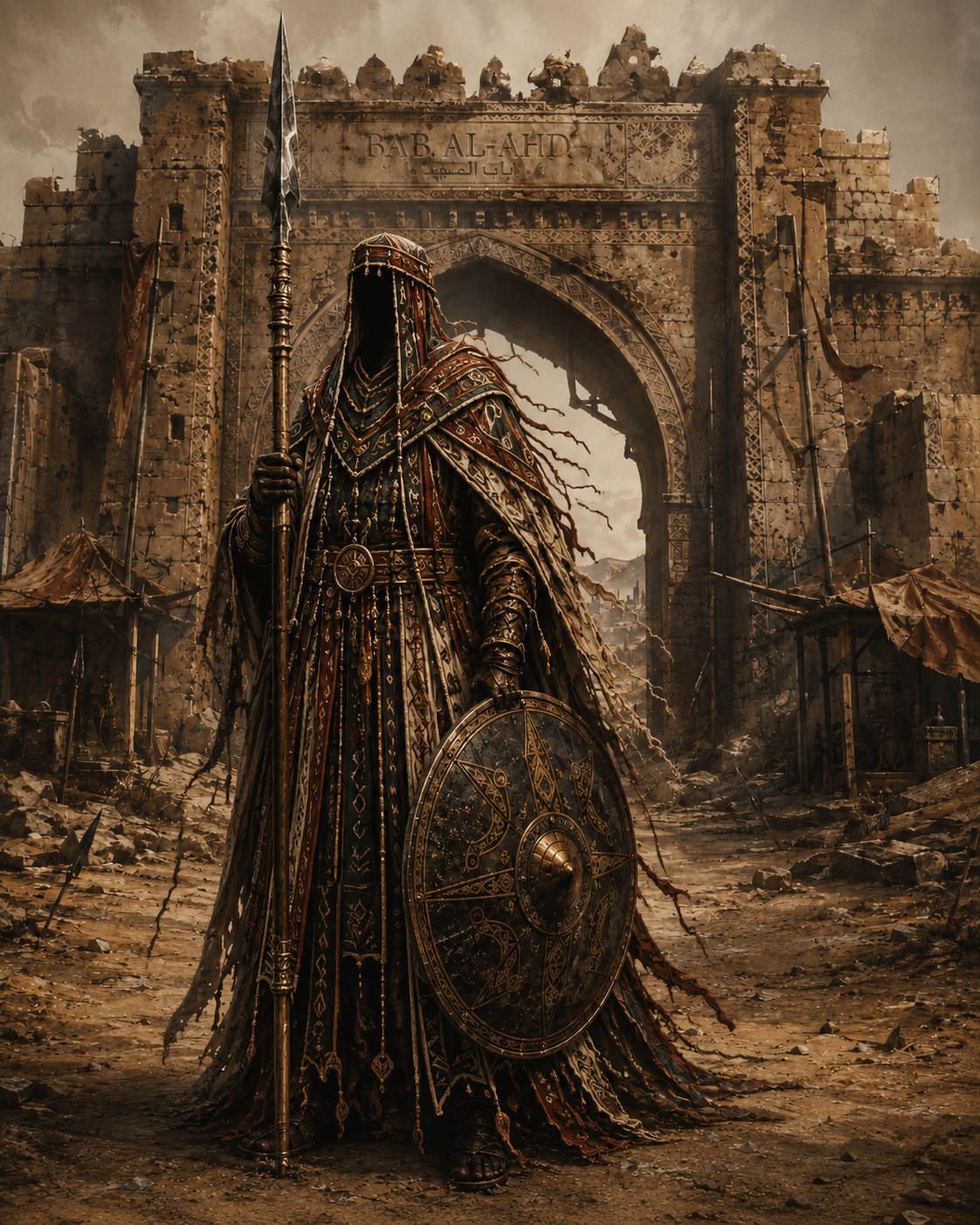
Ayuub keeps watch at Bab al-Ahd, Qamaris' battered threshold, where guard duty, families and travellers remain tangled in old promises.
THE FIGURE AT THE HEART OF THIS REGION
The Oath
Before Rufat had a name, Bab al-Ahd — the Gate of the Oath — stood as the first promise of Qamaris. Its walls guarded the road into the kingdom, but stone was never its true defence. That honour belonged to Ayuub, commander of the gate and one of Samir's most trusted protectors.
Ayuub believed that an oath was not simply something spoken. It was a weight carried until death. To abandon one's post, one's people, or one's king was to abandon part of oneself.
When fear spread through Qamaris, Ayuub did what he had always done. He remained. The soldiers beneath him fled, fell, or disappeared. The gates shattered. The kingdom beyond them changed beyond recognition. Still, Ayuub kept watch.
Some promises survive the people who made them. Some survive far longer than they should.
This is foundational story context for contributors. The deeper cause of what happened to Qamaris is intentionally left unexplained here.
THE PEOPLE OF THIS PLACE
Start with a person, routine or relationship. Each angle below points toward a different kind of story.
Duty can survive its purpose. A tiny shift routine may say more about the gate than another battle story.
The gate was a workplace and a neighbourhood: meals, children, repairs and absences belonged beside weapons and walls.
Use stalls, baggage, animals, repairs and road habits to show that the gate connected Qamaris to a wider world.
VISUAL LANGUAGE
Fortified thresholds, guard shelters, repair yards and roadside trade. The architecture should feel shaped by East African heat, stone, timber, cloth and movement rather than a medieval European castle.
EXAMPLE CONTRIBUTIONS
These are non-canon examples. Use them to understand the scale and tone, then take your idea somewhere different.
A guard Echo keeps checking the road for the soldier meant to replace him. His annoyance slowly reveals friendship, fatigue and the ordinary rhythm of gate duty.
A roadside craftsperson once repaired straps, packs and sandals for people entering Qamaris. Their abandoned stall can contain objects from many regions and tiny hints about who passed through the gate.
A bell no longer makes sound, but nearby Echoes stop mid-loop whenever its rope moves. Different people remember different reasons for fearing it.
QUESTIONS TO CARRY WITH YOU
You do not need to answer every question. One strong answer is enough to begin a contribution.
Who was waiting for a guard to come home?
What promise might someone still be trying to keep?
What market or workshop once served travellers entering Qamaris?
IF SOMETHING SPARKED
A memory, character, sketch, room, object or unfinished thought is enough. The Workshop can help shape it to fit Rufat.