The Shimmering Expanse
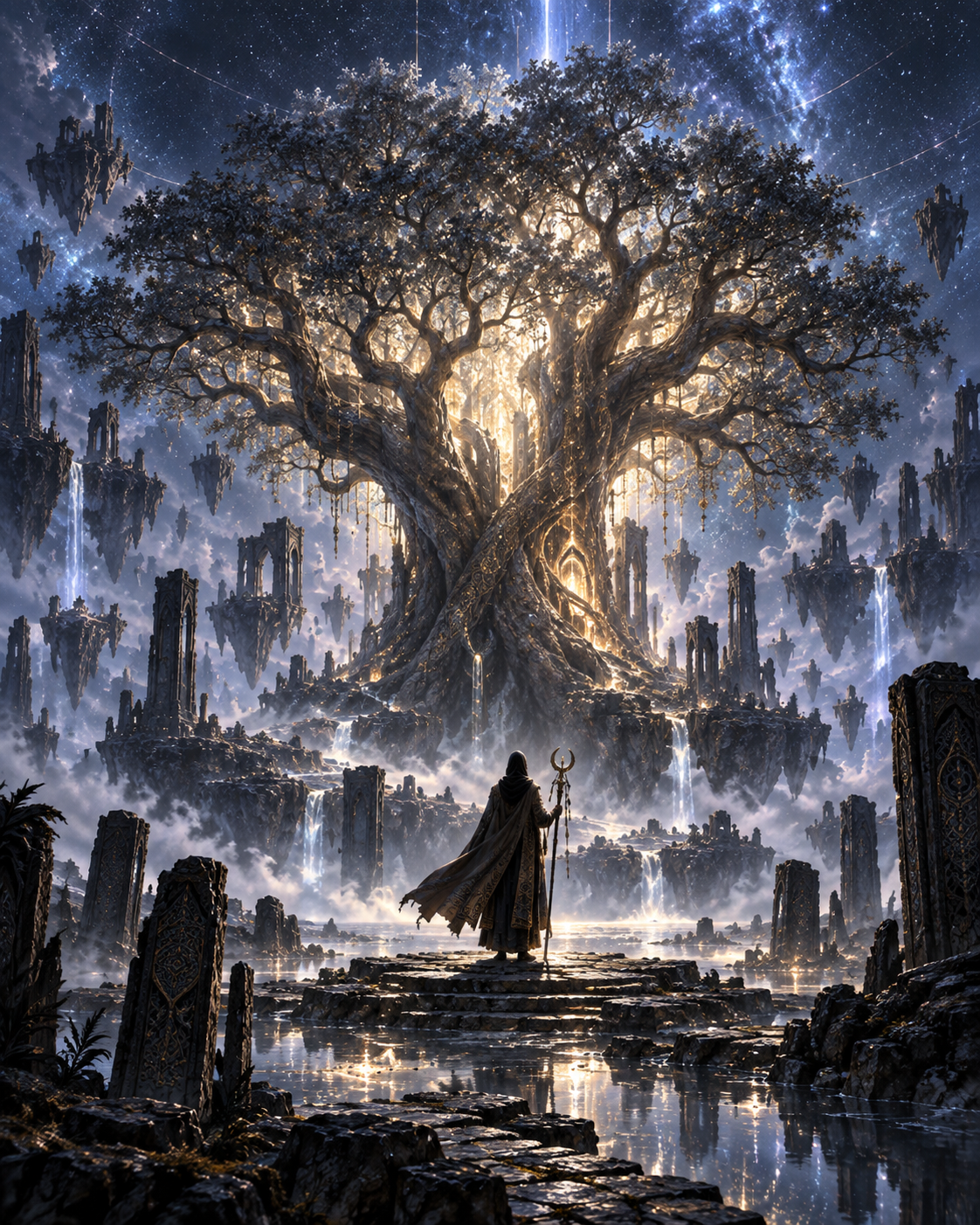
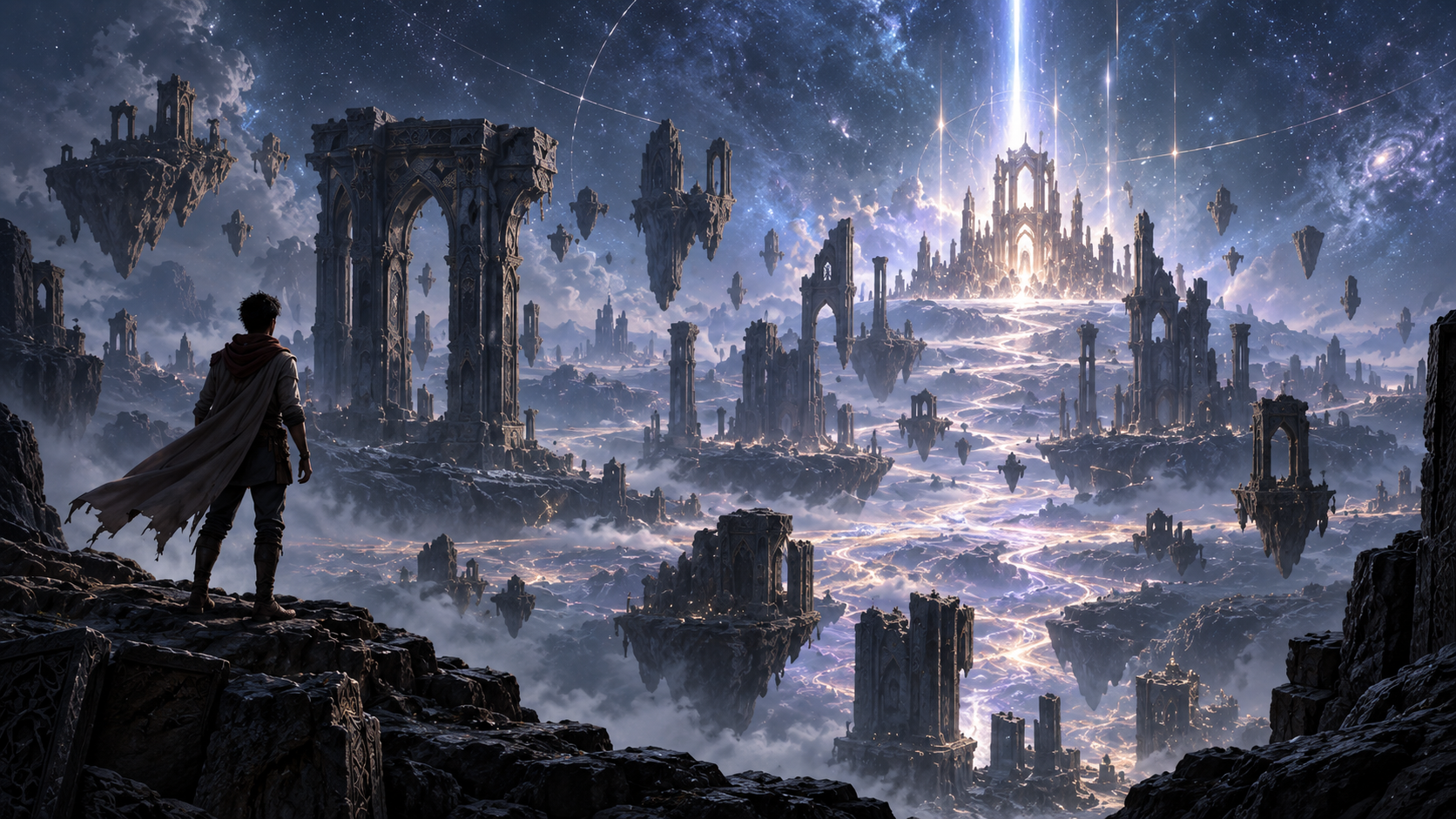
Suspended ruins, impossible horizons and paths of light give Dar al-Athar the feeling of a world rebuilt from traces rather than geography.
Dar al-Athar is a realm of traces rather than certainty: fragments of places, memories and presences gather along Samir's path before his return to Rufat.
IMAGES FROM DAR AL-ATHAR
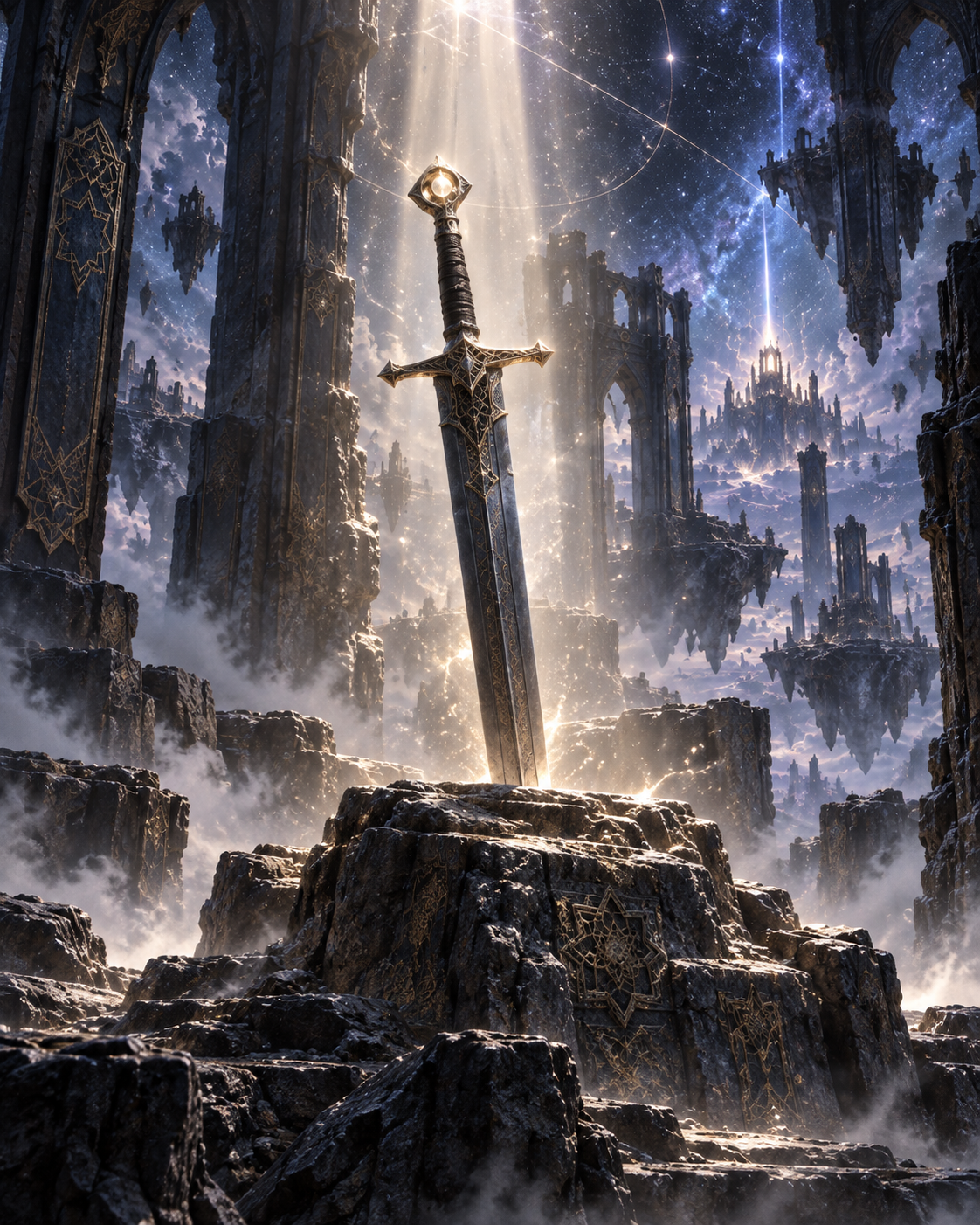
These visual references establish the prologue's atmosphere while keeping the Workshop's existing presentation language.
THE FIGURE AT THE HEART OF THIS REGION
The Trial
Near the end of Samir's passage through Dar al-Athar, he encounters a solitary Keeper who refuses to explain who he is or why Samir has been brought there.
The Keeper tests Samir rather than rescuing him. The encounter should feel deliberate, as though Samir is being measured for something neither he nor the player yet understands.
When the trial ends, the Keeper leaves Samir with Sayf Isat — a weapon tied to memory and truth. The Weavers did not account for this gift, and its meaning should remain unresolved when the prologue closes.
The Keeper gives Samir a way forward, but not an answer.
This is foundational story context for contributors. The deeper cause of what happened to Qamaris is intentionally left unexplained here.
THE PEOPLE OF THIS PLACE
Start with a person, routine or relationship. Each angle below points toward a different kind of story.
A sound, gesture, doorway or path may repeat here without belonging to a literal ghost. Dar al-Athar should feel like memory has left pressure marks on the world.
A courtyard can open onto a cliff, a corridor can contain the weather of another place, and architecture may change when Samir looks away. The realm follows association more than geography.
The Weavers, the Keeper and other traces can move Samir forward while withholding motive. Contributors should deepen mystery without accidentally answering the prologue's central questions.
VISUAL LANGUAGE
A threshold outside ordinary geography: suspended East African-inspired stone forms, fragments of courtyards and paths, deep mist, woven or cloth-like traces, distant silhouettes and impossible transitions. It should feel ancient and quiet rather than like a generic blue ghost world. Familiar forms from Rufat can appear, but incomplete or displaced, as though memory is rebuilding them badly.
EXAMPLE CONTRIBUTIONS
These are non-canon examples. Use them to understand the scale and tone, then take your idea somewhere different.
A carved doorway stands alone in the mist. Passing through it briefly changes the soundscape and reveals the trace of a family courtyard, but no explanation confirms whose memory it is.
Dust rises in the shape of steps ahead of Samir, as though someone is walking a route that no longer exists. Following it reveals a shortcut, a visual story, or a fragment of dialogue rather than a literal spirit.
A distant silhouette of Rufat appears where the horizon should be, but its towers are in impossible positions. Later regions can echo pieces of this view, allowing the prologue to foreshadow places without explaining them.
QUESTIONS TO CARRY WITH YOU
You do not need to answer every question. One strong answer is enough to begin a contribution.
What kind of trace could exist here without being a literal ghost?
How might a familiar place appear when remembered imperfectly?
What could suggest that someone has shaped Samir's path without revealing why?
IF SOMETHING SPARKED
A memory, character, sketch, room, object or unfinished thought is enough. The Workshop can help shape it to fit Rufat.